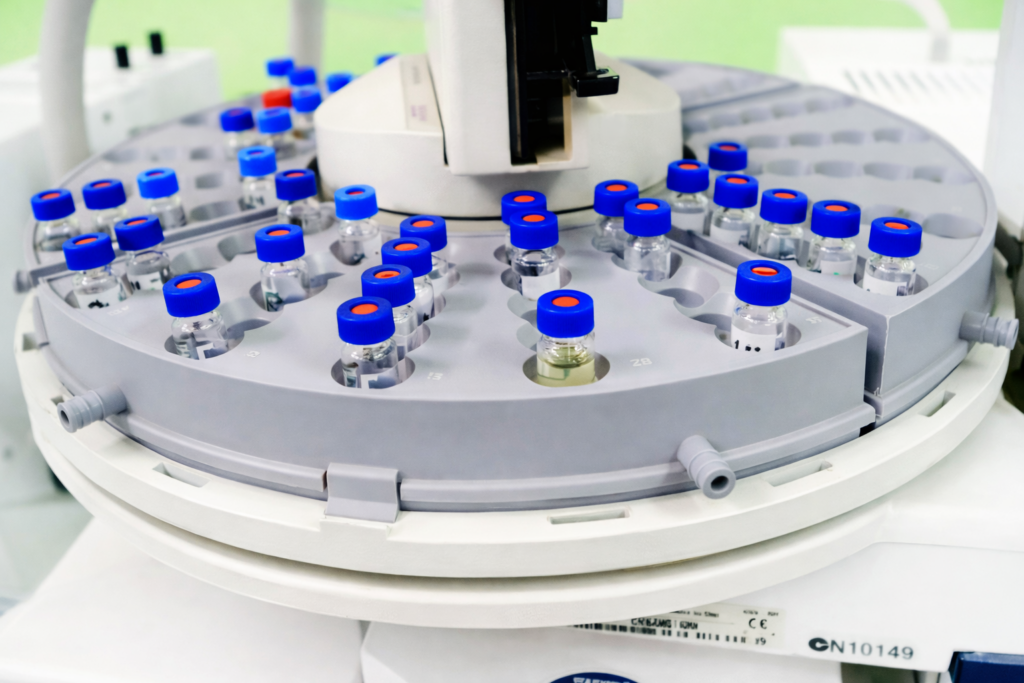
Determination of metal content by Flame Atomic Absorption Spectrometry (FAAS):
- in aqueous solutions,
- in organic, inorganic and mixed organic-inorganic matrix samples (after sample digestion/mineralization), including:
– raw material purity testing,
– determination of metal content in polymeric materials and plastic colorants,
– analysis of the chemical composition of catalysts and aluminosilicates.
Determination of anion content in inorganic samples and aqueous solutions
CONTACT
Dorota Kolasa M. Sc. Eng.
phone +48 517 883 170
dorota.kolasa@ichp.lukasiewicz.gov.pl
- Study of physical and chemical transformations of polymers and other substances by differential scanning calorimetry (DSC) and thermogravimetric analysis (TGA) methods
- Determination of oxidation induction time (OIT) by DSC method
- Study of degradation and decomposition processes of various materials, especially polymeric materials by TGA method
- Thermal stability study of polymeric materials by TGA method
- Flammability testing of polymers and polymeric materials: determining the oxygen index (OI) and conducting flammability tests (e.g., according to UL 94 and HTL-15)
CONTACT
PhD. Sc. Eng. Joanna Sołtysiak
phone +48 517 883 167
joanna.soltysiak@ichp.lukasiewicz.gov.pl
- Testing of properties in static tension
- Testing of bending properties
- Compressive strength test
- Impact testing by Charpy and Izod methods
- Study of dynamic thermomechanical properties (DMTA) in the temperature range -160 oC – 500 oC
- Hardness test by ball pressing method and Shore A and D hardness scale
- Impact tensile test
- Kinematic viscosity test
- Study of the mass flow rate
CONTACT
Agnieszka Szadkowska, PhD
phone +48 453 056 190
agnieszka.szadkowska@ichp.lukasiewicz.gov.pl
- Measurements of fluid dynamic viscosity, viscosity and shear stress as a function of shear rate, determination of plasticizing stress. Fitting measurement data to a rheological model
- Measurement of viscosity according to EN ISO 3219
- Measurements of properties of viscoelastic bodies. Determination of changes in: loss, accumulation, and complex moduli; complex viscosity; phase shift angle as a function of frequency
- Resin curing process test in accordance with ASTM D 4473-01
- Measurement of the gelation process of porous materials (foams)
CONTACT
Jarosław Przybylski PhD. Sc. Eng.
phone +48 453 056 213
jaroslaw.przybylski@ichp.lukasiewicz.gov.pl
- Test of relative hardness of varnish coatings obtained on a glass substrate or in justified cases (e.g., due to the method of coating application) on a metal substrate. Measurement method in accordance with the PN-79/C-81530 standard.
- Control of film formation from aqueous dispersions of polymers and copolymers according to PN-90/C-89415
CONTACT
Izabela Ofat-Kawalec M.Sc. Eng.
phone +48 453 056 211
izabela.ofat-kawalec@ichp.lukasiewicz.gov.pl
- Measurement of apparent viscosity of polymers in liquid, emulsion or dispersion (according to PN-ISO 2555:1999) by Brookfield method
- Measurement of apparent viscosity of petroleum products (according to PN-83/C-04023)
- Determination of UV curing ability of varnish coatings and adhesives and other plastics (in-house procedure)
- Accelerated aging tests in cycles (1 cycle = UV exposure + condensation). Number of cycles and conditions as agreed with the customer or according to the relevant subject standard
- Aging tests under summer and winter conditions in climate chambers providing constant temperature and humidity or under variable conditions (cycles)
- Conditioning of specimens under constant conditions of temperature and humidity in accordance with the subject standard before performing the test described in the standard
- Determination of the percentage of the volume of open and closed pores in rigid porous materials (according to PN-ISO 4590:1994 p. 9)
- Determination of static and dynamic wetting angles, determination of surface free energy of solids from wetting angle data, and determination of surface and interfacial tension of liquids by hanging drop method
- Gloss measurement at 20 degrees, 60 degrees and 85 degrees (according to EN ISO 2813) with statistics and transfer of results to computer and PC software
- Non-destructive measurement of coating thickness on various substrates such as ceramics, glass, plastics (according to PN-EN ISO 2808). Measuring range 13 – 1000 mm
- Tests of elasticity of coating on metal substrate according to PN-EN ISO 1519
- Determination of the resistance of the coating to scratching (scratching the sample with the appropriate tip of a stylus loaded with a defined force of 0-20 N
- Determination of the formability of coatings from paints and varnishes on metal substrates according to PN EN ISO 1520
- Determination of abrasion resistance of coatings and polymer materials by the friction wheel method
- Impact resistance of coatings measured by the falling weight method according to EN ISO 6272
- Determination of adhesion of coatings to the substrate using the cross-section method according to ISO 2409
- Marking the flow and bleeding phenomenon in paints and varnishes according to ASTM D 2801
- Marking of viscosity according to PN-81/C-81508 (flow cups – Ford)
- Determination of drying time and degree of drying according to PN-79/C-81519
- Marking the elasticity of paint coatings by bending according to PN-76/C-81528
- Marking the adhesion of coatings to the substrate according to PN-80/C-81531
- Marking the resistance of paint coatings to water according to PN-76/C-81521
- Determination of mechanical stability of aqueous dispersions and suspensions in a centrifuge in the temperature range of -100C – + 400C (up to 18,000 rpm)
- Determination of sedimentation of aqueous dispersions according to BN-74/6351-01
CONTACT
Jarosław.Przybylski PhD. Sc. Eng.
phone +48 453 056 213
jaroslaw.przybylski@ichp.lukasiewicz.gov.pl
Izabela Ofat-Kawalec, M. Sc. Eng.
phone +48 453 056 211
izabela.ofat-kawalec@ichp.lukasiewicz.gov.pl
Testing of active substances, medicinal products, excipients, pharmaceutical raw materials in accordance with Ph. Eur., USP, FP in the GMP standard
- Batch certification for GMP compliance (certificate) for quality control of medicinal products, active substances and excipients and raw materials
- Pharmaceutical availability studies for various pharmaceutical forms
- Stability testing of active substances and medicinal products in qualified climate chambers under long-term conditions
- Impurity profile testing – detection, identification and quantification of impurities according to the requirements of pharmacopoeial monographs (USP, Ph. Eur., FP), recommendations of the International Conference on Pharmacopoeia (ICIP), and the International Conference on Pharmacopoeia (ICP). Harmonizacji (ICH), wymaganiami Europejskiej Agencji ds. Leków (EMA) oraz amerykańskiej Agencji ds. Leków i Żywności (FDA)
- Determination of trace element content (ICP-MS)
- Standardization of patterns of active substances and their impurities
- Sterility test
- Microbiological purity test
- Studies on the presence of bacterial endotoxins
- Testing the effectiveness of antimicrobial protection and disinfectant efficacy
- Cleanroom Microbiological Monitoring
- Development and optimisation of analytical methods
- Verification and validation of analytical and microbiological methods
- Validation of methods for the determination of residues of substances in the process of cleaning the production line
- Transfer of analytical methods
Pharmacokinetic studies, including equivalence and bioavailability studies of medicinal products in accordance with the GLP standard
- Study design preparation
- Development or adaptation of a bioanalytical method for the determination of a medicinal substance and/or metabolites in biological material
- Validation of the bioanalytical method in accordance with EMA requirements
- Performance of assays in a biological material (HPLC, LC/MS/MS)
- Pharmacokinetic calculations (WinNonlin)
- Documentation of the study in CTD format Module 5
- Preparation of expert opinions
CONTACT
Aneta Łukomska, PhD Sc.
phone: +48 453 056 148
aneta.lukomska@ichp.lukasiewicz.gov.pl
- identification of organic compounds, polymers, plastics, paints, glues, binders, etc. by spectrophotometric and chromatographic methods;
- identification and structure studies of non-volatile organic substances, e.g. synthetic and natural polymers, biochemical and geochemical products using the Py/GC/FTIR method;
- determination of average molecular weights and molecular weight distribution of polymers by gel permeation chromatography (GPC);
- analytical studies of organic compounds using FTIR and UV-VIS absorption spectrophotometry methods;
- studies of the curing and cross-linking of macromolecular compounds using the FTIR method (determination of functional groups);
- compositional analysis (identification of volatile components) of mixtures of organic compounds using GC/MS and GC/AED methods;
- determination of trace amounts of toxic substances (monomers and solvents) in plastic and other products by GC method using head-space technique, flame ionization detectors (GC/FID) and atomic emission detectors (GC/AED) and electron capture detectors (GC/ECD);
- determination of C1–C3 alcohol content in household chemical products and pharmaceutical products using the GC/FID method;
- determination of the content of organic acids, hydrocarbons, alcohols, esters and ketones in gas samples by GC/FID;
- testing the migration into food simulants and the emission of trace amounts of substances from plastic products into the atmosphere using spectrophotometric and chromatographic methods;
- control of the purity of chemical raw materials and testing of technological processes using UV, GC, FTIR and AAS methods.
CONTACT
Joanna Sołtysiak, PhD. Sc.
phone +48 517 883 167
joanna.soltysiak@ichp.lukasiewicz.gov.pl
- determination of volatile odour compounds and aromas using GC-MS
- determination of organic compounds in cosmetic raw materials using gas chromatography methods (GC/MS, GC/FID)
- identification of volatile organic compounds in various matrices using SPME-GC/MS and HS-GC/MS techniques
- analysis of gas samples using GC/MS and GC-FID/TCD methods
- analysis of the identity and purity of chemical substances using GC/MS, HPLC, and GC/FID methods
- analysis of solvent composition using gas chromatography methods
- determination of cations and anions in aqueous solutions and in gas using ion chromatography (IC)
- determination of water content in hydrogen using the CRDS method
- determination of water content by Karl Fischer coulometric titration according to PN-EN ISO 12937 and ASTMD 6304
- determination of water content by Karl Fischer potentiometric titration
- determination of bromine index by coulometric titration according to ASTMD1492
- determination of bromine number by coulometric titration
- determination of density – hydrometer method according to ASTMD 1298 and PN-EN ISO 3675
- determination of density – pycnometer method
- determination of free water content according to ASTMD 2709
- determination of the content of unsaponifiable substances in vegetable and animal oils and fats according to PNISO 3596
- marking of insoluble contaminants in vegetable and animal oils and fats according to PN-EN ISO 663
- determination of iodine value according to PN-EN 14111
- determination of the peroxide value in vegetable and animal oils and fats according to PN-EN ISO 3960
- determination of saponification value according to PN-C-04043
- determination of acid value according to PN-EN 14104 and PN-ISO 660
- determination of water content and volatile substances in vegetable and animal oils and fats according to PN-EN ISO 662
- aniline point determination according to ASTMD 611
- determination of asphaltene content according to ASTMD 3279
- determination of the flow temperature according to PN-EN ISO 3016
- determination of the refractive index according to ASTMD 1218
CONTACT
Dominika Kubica, PhD. Eng.
phone +48 517 883 165
dominika.kubica@ichp.lukasiewicz.gov.pl
Małgorzata Walkiewicz, M. Sc.
phone +48 517 883 168
malgorzata.walkiewicz@ichp.lukasiewicz.gov.pl
- development of new analytical methods and procedures using high-pressure liquid chromatography;
- determination of mixtures of organic compounds with particularly complex and difficult to analyze compositions by HPLC.
CONTACT
Zbigniew Dąbrowski, PhD. Sc.
phone +48 517 883 149
zbigniew.dabrowski@ichp.lukasiewicz.gov.pl
Research offering
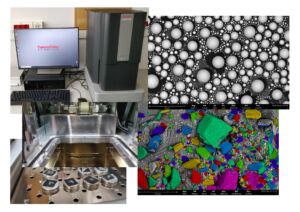
- analysis of the surface morphology and topography of materials, including determination of particle size, pore size, and coating thickness at the micro- and nanometer scales. High-resolution imaging of solid surfaces (JPEG, TIFF, PNG)
- qualitative and semi-quantitative analysis of elemental composition using an energy-dispersive X-ray spectrometer (EDS) performed in a micro-area of the sample surface. Capability to map elemental distribution (elemental mapping) and perform line scans. The range of elemental analysis extends from boron to the heavy elements of the periodic table.
Scanning Electron Microscope with EDS X-ray Microanalyzer
- ability to observe the surface of materials using secondary electron detection (SED), backscattered electron detection (BSD) and in mixed mode (MIX)
- resolution <10 nm;
- accelerating voltage from 5 kV to 20 kV
- structural studies of solids in the magnification range of 160 to 200 000x
- ability to combine images from several SEM photos
- ability to test large samples (max. 100 x 100 x 40 mm)
- ability to test non-conductive samples – after prior sputtering with gold or carbon
Three modes of microscope operation:
- high vacuum (0,1 Pa) – testing of conductive materials, e.g. metals and their alloys
- high vacuum (0,1 Pa) – testing of conductive materials, e.g. metals and their alloys;
medium vacuum (10 Pa) – testing of materials with moderate permeability, e.g. composite materials - low vacuum (60 Pa) – testing of non-conductive materials, e.g. ceramics and polymers
The customer receives:
- high-resolution SEM images
- EDS spectra
- elemental distribution maps
- summary of the analysis results
- interpretation and expert conclusions
- report in PDF or DOC format
CONTACT
Kamil Wróbel, PhD. Sc.
phone +48 517 883 172
kamil.wrobel@ichp.lukasiewicz.gov.pl
Laundry detergents: evaluation of washing performance under real conditions, testing of washing capacity, encrustation, decrease in tear strength, greying, yellowing, shrinkage, discolouration, maintenance of whiteness, softening of washed products.
- Liquid dishwashing detergents: test of washing capacity (IKW test, direct washing test) test of fat emulsifying capacity.
- Sanitary cleaners: test of limescale-dissolving capacity.
- Cleansing milks and powders: testing of washing capacity and surface damage.
- Glass cleaners: testing of dirt-removing capacity, dry matter, alcohol content.
- Shampoos: testing of foaming capacity.
- Analytical and physico-chemical testing of raw materials and finished products.
Research equipment
- Wet Abrasion Scrub Tester 903/PG, SheenInstruments Ltd
- DataColor 400 spectrophotometer
- Komora True View 2 DataColor
- Micro-TRI-gloss meter, BYK-gardner
- Soxtec System 2 HT2 kits, Tecator
- Muffle furnace 48000, Thermolyne
- Testing machine LRX, Lloyd
- Equipment to evaluate the washing ability of hand dishwashing detergents
- Rotary-oscillation washer
- Dishwashers, Siemens
- Foaming capacity and foam persistence index evaluation equipment
- Equipment for assessing descaling capacity
- RVF viscometer, Brookfield
- Mettler Toledo PM400 vagranspirator
CONTACT
inż. Renata Dudek
phone +48 517 883 166
renata.dudek@ichp.lukasiewicz.gov.pl
Conducting laboratory and application research and design work in the field of:
- using distillation and rectification operations to purify substances and divide technological streams; modeling the operation of continuous and periodic systems with particular emphasis on azeotropic phenomena;
- computer-aided design of industrial installations, especially the design of rectification columns and heat exchangers using simulation programs from the ChemCAD package;
- design and optimization of distillation processes, including extractive and absorption distillation;
- using the crystallization operation from the melt (from the mass) to purify chemicals,
- gradual liquefaction of process gases;
- distillation of organic fractions, including oil fractions from the depolymerization of plastics, in accordance with the Customer’s requirements.
CONTACT
Marek Plesnar, M. Sc. Eng.
phone +48 453 056 217
marek.plesnar@ichp.lukasiewicz.gov.pl
M. Sc. Eng. Piotr Lewandowski
phone +48 517 883 152
piotr.lewandowski@ichp.lukasiewicz.gov.pl
Conducting laboratory, large-scale and pilot-scale research on the application of various membrane techniques in the purification and separation of liquid and gaseous process streams, in particular:
- developing new and modernizing existing production processes by introducing hybrid solutions combining membrane processes with classical techniques for purifying and separating liquid process streams;
- introduction of membrane techniques in industrial wastewater treatment processes with particular emphasis on recycling water and components (e.g. glycols, glycerine or valuable metals) separated from the processed streams;
- use of membrane techniques for gas separation, including CO2 extraction from power plant exhaust gases – research carried out at our own, unique large-scale laboratory facility;
- laboratory and pilot scale studies of the pervaporation process with applications in the separation of azeotropes and liquid water-organic mixtures.
We guarantee the development of an equipment solution tailored to the individual needs of the client and the technological process
CONTACT
Wiesław Capała, M. Sc. Eng.
phone +48 517 883 155
wieslaw.capala@ichp.lukasiewicz.gov.pl
We offer services in the field of:
- synthesis, optimization and modification of special and vinyl polymers [poly(phenylene oxide) and poly(methylene oxide), polystyrene, polyacrylate, poly(vinyl chloride), poly(vinyl butyral)] and auxiliary raw materials for PVC and PVB processing (e.g. plasticizers, stabilizers);
- scaling up processes conducted in laboratory conditions;
- preparation of technological assumptions for the design of industrial installations for the developed processes;
- development of recipe compositions and technologies for the preparation and processing of PVC and PVB mixtures;
- development of technologies for standardization and use of PVC and PVB waste;
- supervision over the implementation of the developed technologies;
- expert advice.
When carrying out research and design work, we take into account:
- market analysis in terms of the availability of similar solutions and the need for new technologies and raw materials;
- economic aspects of solutions;
- individual customer needs.
We have research facilities, including a pilot plant for process scaling and analytical facilities.
CONTACT
PhD. Sc. Eng. Agnieszka Abramowicz
phone +48 453 056 208
agnieszka.abramowicz@chp.lukasiewicz.gov.pl